
Divination & Rituals
FREE SPIRITUAL RESOURCE LIBRARY
Spiritual Practices, Sacred Connections and Personal Magic
A dream may carry a message. A card may reveal an insight. An intuitive impression may give us a question to sit with. A personal ritual may bring intention into expression.
Here, divination A collection of practices that seek insight through symbols, questions, observation or spiritual interpretation. Practitioners may use cards, dreams, pendulums or other methods to reflect on experiences and consider possibilities. A divination method is distinct from its instrument: cartomancy is a practice, while cards are tools. Some self-discovery systems also have divinatory applications without being exclusively divination practices.
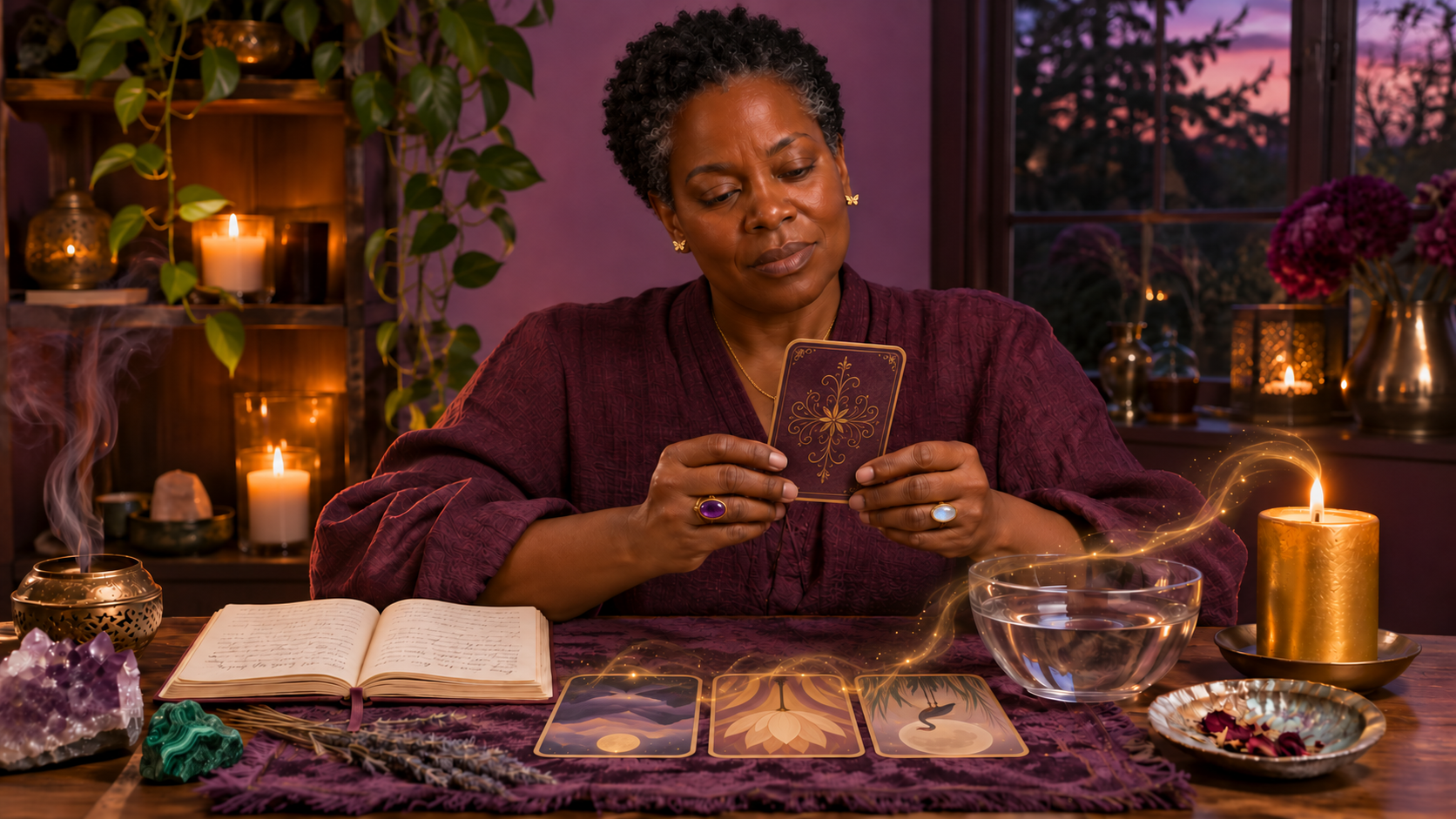
Practices and Resources
Start with what draws your attention. These resources offer teachings, tools and practices you can bring into your own spiritual life.
Divination and Spiritual Insight
Divination offers ways to receive, interpret and engage with spiritual information. Dreams, cards, visions and intuitive senses provide different approaches to spiritual communication, insight and discernment.
As you work with these practices, notice how messages reach you and what helps you make sense of them.
Dreamwork and Dream Symbolism
Dreams may carry spiritual messages, personal symbols and glimpses of what comes into awareness during sleep.
Learn to recall your dreams, recognize recurring symbols and bring what you learn into your waking life.
Tarot and Oracle Cards
Tarot and Oracle cards offer pathways for divination, spiritual communication and intuitive insight.
Look up Tarot meanings, meet the Living Visions Oracle and try interactive readings to reflect on the messages and possibilities within each card.
Clairsenses and Intuitive Perception
Spiritual perception may reach us through visions, sounds, sensations, direct knowing and other sensory experiences.
Get to know six clairsenses In spiritual traditions, clairsenses describe forms of intuitive perception experienced as impressions, images, sounds, sensations, emotions or inner knowing. Each clairsense describes a different way of experiencing intuitive information.
Rituals and Sacred Practices
Rituals give form to intention. They offer ways to engage with energy, honor significant experiences, connect with Spirit and express what holds meaning in our lives.
A ritual may be spontaneous or carefully prepared, simple or elaborate. Its expression reflects our intentions, spiritual relationships and personal traditions.
Rituals and Ceremonies
The collection includes Transcendent, Protection, Empowerment and Life-Cycle Rituals.
Discover practices for spiritual connection, energetic protection Intentional spiritual practices for maintaining one's perceived energetic boundaries, including prayer, visualization and ritual.
Expanding Our Practices
The Divination & Rituals collection continues to grow, bringing new opportunities to engage with spiritual tools, sacred spaces and meaningful connections.
Divination Tools
Pendulums and Dowsing A practice in which people use pendulums, rods or other methods to interpret movements as responses to questions. In spiritual practice, dowsing may serve as a tool for reflection and exploration of intuition. Methods include instrument-based and bodily approaches; applications such as water dowsing are distinct from the method used. Involuntary muscular activity can influence instrument movements. Dowsing is not a scientifically established way to locate hidden targets. Gazing into a reflective surface, flame or other visual medium as a practice of intuitive reflection or divination. Practitioners attend to images, impressions and associations that arise during the experience.
Use divination tools and visionary methods to ask spiritual questions, notice shifts in energy and work with intuitive impressions.
Pendulums and Dowsing
Sometimes my body screams yes. Other times, she whispers. She communicates with me through movement, physical sensations and intuitive knowing.
Dowsing is one way I practice divination. I bring a question and notice how my body responds or how the pendulum A weight suspended from a fixed point so it can swing. In divination and dowsing it is held or suspended and its movements are interpreted according to the practitioner’s method. This entry describes the instrument rather than the practice.
I use my physical pendulum to explore what I intuitively sense and guide my energy work Intentional practices that engage with the experience of subtle energy within and around the body. Energy work may incorporate breath, intention, sound, movement, visualization, touch and spiritual tools.
A yes in my body generally feels open and flowing. Sometimes I feel an urgency to act. Other times, I experience subtle sensations that I intuitively interpret as an invitation to act or observe. A no often presents as tightness, sharpness, pain or friction.
Doubt and uncertainty sometimes present through similar sensations. I cultivate discernment through observation, pattern recognition and self-trust. I learn when to honor a no, when to explore a sensation further and when to move forward in the presence of discomfort.
When I recognize my attachment to a particular outcome, I practice detachment. I may reframe my inquiry, explore my sensations or revisit the question at another time. Sometimes I break an action into smaller steps, redirecting my focus and attention to what is right in front of me, taking one breath and one moment at a time.
Dowsing is one of the ways I deepen my intimacy with myself. As I learn how my body communicates with me, I trust myself more in the choices I make.
A Practice in Dowsing
- Find a comfortable position and bring your awareness to your breath, natural movements and physical sensations. If you are using a physical pendulum, hold it by its chain or cord.
- Begin with a few simple questions to which you already know the answers. Observe the movements of your pendulum, your body or both. Notice any similarities, differences or emerging patterns.
- Think of something simple you are considering doing today. Ask a question about that action or the first step toward it.
- Observe any movements, sensations or intuitive impressions before interpreting them. Acknowledge any desires, expectations or emotions that arise.
- If the response feels unclear, explore your sensations, reframe your question or revisit it at another time. Instead of asking, “Am I ready to complete this project?” you may ask, “Am I ready to spend five minutes working on it?”
As you return to this practice, notice recurring patterns and give yourself space to develop your discernment. Your observations can inform your choices while you retain responsibility for your decisions.
Reflection
What am I learning about the way my body communicates with me?
Ritual Arts and Sacred Spaces
Sacred Spaces and Personal Altars · Candlework · Sigils and Sacred Symbols · Energetic Protection
Discover ways to create intentional spaces, work with sacred symbols and develop personal rituals for spiritual expression and energetic engagement.
Sacred Spaces and Personal Altars
I create sacred spaces wherever I desire to cultivate an intentional connection with myself, my ancestors, Spirit or the energies I choose to honor. My presence, intentions and the energy I cultivate within a space are what make it sacred to me.
A sacred space may be physical, internal, temporary or permanent. I recognize my body as a sacred space. I honor her through my breath, movement, intention and awareness of the energies I experience within and around me.
I also create spaces within my environment that support my spiritual practices. A personal altar gives physical expression to an intention, relationship or energy I desire to honor and nurture.
I choose what belongs on my altars based on my intuition, personal associations, spiritual connections and the purpose of the space. Each object, element and offering carries significance within my practice.
When I create an ancestral altar, I select a designated space, such as a tabletop, where I can honor and commune with my ancestors. I incorporate representations of the four elements: fire, air, water and Earth.
I light a candle to represent fire, burn incense to represent air, place a glass of water on the altar and incorporate tobacco or fresh flowers to represent Earth. I personalize the space with photographs, trinkets, personal belongings or objects that evoke cherished memories of my ancestors.
I arrange my altar intuitively, creating a space that reflects my relationship with my ancestors and the connection I desire to nurture.
Tending my altars is part of my spiritual practice. I refresh the water and replace offerings. My intuition, the whispers of Spirit and direct communication with my ancestors inform what I offer and when I offer it. I practice discernment as I receive and respond to this guidance.
I speak to my ancestors directly, candidly and with reverence. I express gratitude, share what is happening in my life, ask questions, seek assistance and request continued guidance and protection. I also create space to listen, receive and acknowledge their presence in my life.
As my spiritual practice evolves, so do my sacred spaces. I pay attention to what feels energetically aligned, what calls for my attention and what I feel ready to release. I give myself room to rearrange, replenish and transform these spaces as I grow.
Making Space for the Sacred
Creating a sacred space offers an opportunity to explore what you value, what you desire to cultivate and how you connect with yourself and the energies you honor.
A single meaningful object, a cherished memory or an intention is enough to begin cultivating your sacred space.
Choose a space that feels inviting to you. It may be a tabletop, a shelf, a windowsill, a corner of a room or a place in nature.
- Establish your intention. What do I desire to honor, nurture or cultivate within this space?
- Select meaningful objects. What objects, elements or symbols resonate with my intention and carry personal significance?
- Arrange your space intuitively. How do I feel as I place each object? What feels aligned with my intention?
- Connect with your space. Spend a few moments breathing, speaking your intention and bringing awareness to your senses. What do I experience in my body? What impressions arise?
- Nurture your connection. Return to your space as you feel called. What needs my attention? What do I desire to replenish, rearrange or release?
If you incorporate candles or incense, use heat-resistant holders, maintain adequate ventilation and extinguish them before leaving the space.
As you cultivate your sacred space, notice how your relationship with it evolves. What begins as an expression of intention may become a place of remembrance, restoration, discovery, spiritual connection and personal transformation.
Candlework for Intention Setting · Creating a Space for Ancestral Remembrance
Candlework for Intention Setting
Candlework is one of the ways I connect with the elements, direct my energy and bring awareness to my intentions. My practice is rooted in both my shamanic work and Hoodoo. I light candles to clear energy, protect my space and invoke energies, frequencies and spirits to help activate the sequence of events aligned with my intentions and rituals.
My relationship with candlework continues to evolve. I connect with the element of fire through physical candles, fire gazing and visualization. Candlework has become increasingly somatic for me.
I am the candle and the flame.
My body is the tool, the vessel, the compass and the pendulum. My body shows me the way. I experience my connection with the elements as grounding, nourishing and protective.
A Candlework Practice
You may explore this practice with a physical candle or through visualization.
- Identify your purpose. What do you desire to clear, protect, invoke, activate, release or understand?
- Connect with the flame. Light a candle in a safe space or visualize a flame within your body. Bring your awareness to its presence and energy.
- Direct your energy. Speak your intention aloud, write it down or hold it within your awareness as you connect with the flame.
- Listen to your body. Observe your breath, sensations, emotions, thoughts and any intuitive insights that arise. Give yourself space to witness what you experience before assigning meaning to it.
- Reflect and integrate. Ask yourself, What is one choice I can make today that reflects this intention? Keep any physical flame attended throughout the practice and safely extinguish it when you finish.
What informs the intentions you set? Your desires, beliefs, emotions, experiences and subconscious patterns may influence what you seek to create, release or experience.
I invite you to explore my Intentions Framework to deepen your awareness of the intentions you hold and what influences them.
Your relationship with candlework and the elements is yours to discover. You may come to learn, grow, witness, observe or deepen your understanding of yourself.
May you receive the clarity and insight that serve your highest good.
Ancestral Connections and Sacred Remembrance
Ancestor Work · Ancestral Altars · Remembrance Practices
Get to know your lineage and spiritual heritage through practices that honor those who came before you.
Ancestral Remembrance
Choose an ancestor, a family story or a tradition you feel drawn to honor. Take a breath and recall one detail you want to carry with you. Speak that detail aloud or write it down. Name one way you can honor it in your life today.
Reflection prompt What do I choose to carry forward from those who came before me?
Creating a Space for Ancestral Remembrance
A photograph can take me back to a moment I feel again in my body. I call this timeline jumping. I also keep meaningful objects and written memories that connect me with my lineage.
I nurture my connection with my ancestors through remembrance, conversation, gratitude, reflection and offerings. Within this connection, I experience comfort, protection, joy and love.
I invite you to create a space for ancestral remembrance Intentionally honoring the lives, experiences, wisdom and cultural inheritance of those who came before us. Remembrance may take shape through storytelling, prayer, food, music, meaningful objects, rituals and the continuation of ancestral traditions.
Give your remembrance a physical place. This may be on a shelf, inside a drawer, within a journal or in a dedicated area of your home.
Our relationships with our ancestors and our knowledge of our lineage vary. Honor your experiences, your curiosity and your personal boundaries as you create this space.
When you return, you may speak a name, revisit a memory, express gratitude or notice what arises within your body and senses. Choose a gesture that resonates with you in that moment.
Reflection
What do I want to reconnect with each time I return to this space?
Additional resources will join this collection as Healing through Visions expands.
Make the Practice Your Own
Your spiritual practice belongs to you.
I invite you to follow your curiosity, honor what you experience and carry forward what feels meaningful to you.
Thank you, Spirit. Àṣẹ.
If you desire personalized support, I offer Visionary Guidance, Energy Alignment and Sacred Immersions through Healing through Visions. Bring your intentions, spiritual questions and personal practices into our work together.